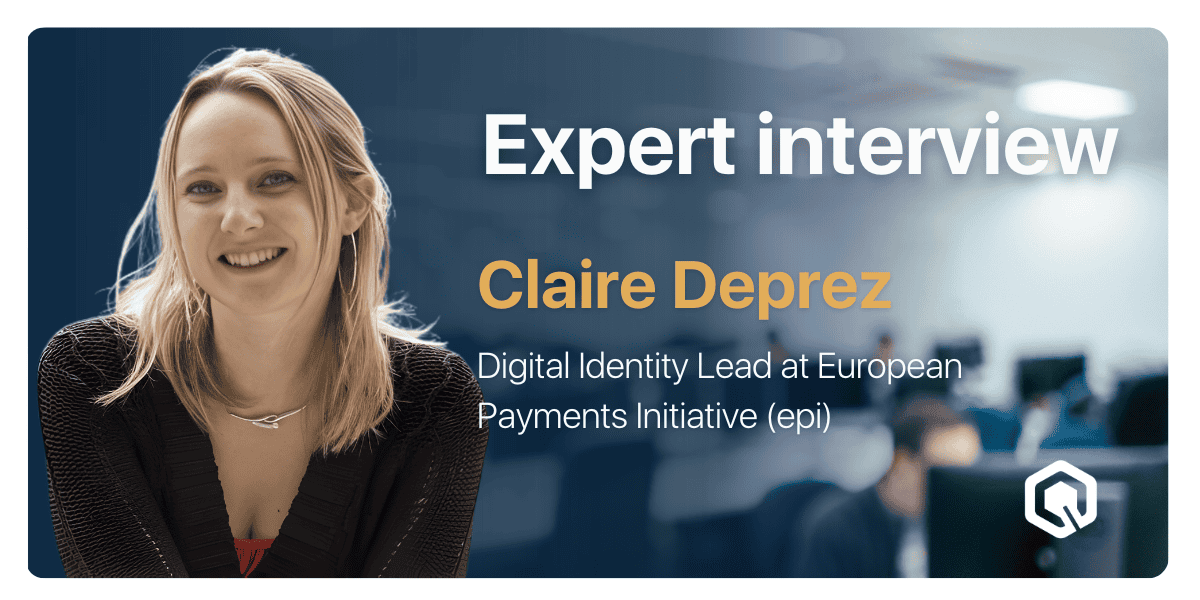
Europe’s future of digital identity and payments will be increasingly connected, they will converge but not always merge, says Claire Deprez-Pipon, Digital Identity Lead at the European Payments Initiative (EPI). Real progress will depend less on turning every identity wallet into a payment wallet and more on orchestrating the complex payment ecosystem through pan-european and sovereign payment solution like Wero, creating seamless interoperability between the two, allowing citizens to move effortlessly between authentication and payment while maintaining security, trust, and choice.
Claire leads the development of EPI’s digital identity strategy for Wero, the pan-European payment solution. Her mission is to understand how the upcoming EUDI Wallet will impact payment flows, ensure regulatory compliance, and explore business opportunities at the intersection of identity and payments.
Bringing identity and payments together
A convergence between digital identity and payment systems could transform how Europeans prove who they are and pay online. One of the simplest use cases is strong customer authentication, where a payment is approved through a verified digital identity. But Claire sees more potential: “Imagine buying alcohol and confirming in the same step that you’re over 18, without sharing your birth date, or booking a hotel and instantly sharing verified identity data along with the payment. It would make transactions faster, safer, and cheaper.”
At the same time, she stresses that turning the EUDI Wallet into a full-payment wallet would be extremely challenging. Payments are highly regulated, operationally complex, and fragmented across schemes, methods, wallets, and actors such as merchants, PSPs, acquirers, and issuers.
“Identity and payments are two different worlds, with different risk models, business stakeholders, and regulatory frameworks,” Claire points out. “Rather than expecting the EUDI Wallet to absorb all this complexity, the smart move is to let it excel at identity while relying on specialised payment solutions like Wero to handle payments and create the synergy between the two.”
Some member states, such as France, want to keep identity and payment clearly them separated, while others – like Poland or Italy – allow limited payment functions, such as paying taxes, within the identity wallet.
Claire sees these approaches as complementary, not contradictory: “What matters is that citizens can move smoothly from proving who they are in their EUDI Wallet to paying with a trusted solution, without friction and without losing control over their data.”
Learning from payments infrastructure
Banks and fintechs will be critical to making the EUDI Wallet succeed. As Relying Parties, they’ll use it to verify users during onboarding or authentication, replacing costly manual checks or video calls. “For banks, this means big cost savings and a smoother user experience,” Claire says. The same logic applies across industries, from telecoms to e-commerce – wherever identity proofing is needed.
Claire also highlights that payments have evolved through decades of coordination between banks, acquirers, PSPs, and merchants: a process that can’t simply be reinvented inside an identity wallet. Even a small technical change can ripple through the entire ecosystem.
“We learned this with PSD2,” she notes. “It took years to align everyone and achieve a good user experience. Expecting the EUDI Wallet alone to take over that role would underestimate the complexity of payments”. This is where she sees Wero as a unique lever. “Wero is designed as a pan-European payment solution that already understands this complexity. If we connect Wero natively with the EUDI Wallet, we can offer a truly sovereign experience where identity and payments reinforce each other.
At the same time, regulation remains a moving target. While eIDAS 2 introduces “strong user authentication,” PSD2 still mandates “strong customer authentication” – a subtle but important distinction. Future clarity is expected through the Payment Services Regulation (PSR) and ongoing large-scale pilots like EWC and NOBID, which have been working with the European Commission on a unified payment authentication framework. Those works will be piloted with the new large-scale pilots APTITUDE and WEBUILD in the next 2 years.
Adoption, trust, and the human factor
The European Commission’s goal is for 80% of EU citizens to use the EUDI Wallet within five years. This is ambitious but achievable, Claire thinks – if the ecosystem delivers value. “People won’t adopt the wallet just to store their digital ID,” she says. “They need real services: payments, onboarding, access to public and private platforms.” She points to Belgium’s itsme and the Nordics’ BankID as models: their adoption soared past 80% once payment authentication were integrated.
Claire believes adoption will follow a similar curve to mobile payments: slow at first, as people get familiar with the technology and trust it, then accelerating rapidly once more services and relying parties (banks, merchants, public agencies) start supporting it. This pattern reflects the Innovation Adoption Life Cycle, where early adopters and tech enthusiasts pave the way, followed by a ‘tipping point’ when the early majority embraces the technology – turning it from a niche innovation into a mainstream necessity. Once that critical mass is reached, usage tends to grow exponentially as late adopters follow social and practical momentum.
Still, trust remains a major hurdle. In some countries, citizens fear that a digital wallet will give governments too much control. Switzerland’s narrow referendum approval earlier this year underlines that tension. “Some people are still afraid of ‘Big Brother,’” she says. “We need to show them it’s the opposite: the wallet gives them control over their own data.”
The path ahead and WERO’s role
Claire does not argue against the idea of a powerful, citizen-centric app; rather, she is realistic about where such integration can happen. “A single ‘super app’ trying to be everything for everyone at EU scale is politically and technically unlikely,” she explains. “But a sovereign payment solution like Wero, tightly integrated with the EUDI Wallet, can in practice deliver this unified experience for identity and payments.”
She envisions two complementary layers that feel unified from the user’s perspective: on one side, the EUDI Wallet as the trusted identity layer provided by Member States; on the other, Wero as the pan-European payment layer that can orchestrate schemes, banks, and merchants. “If moving from your EUDI Wallet to payment wallet is instant and transparent, people won’t care which app is doing what in the background. The goal is to make it feel like one experience – with identity and payment reinforcing each other – while keeping both worlds robust, compliant, and sovereign.”