





Building QTSP-ready trust services

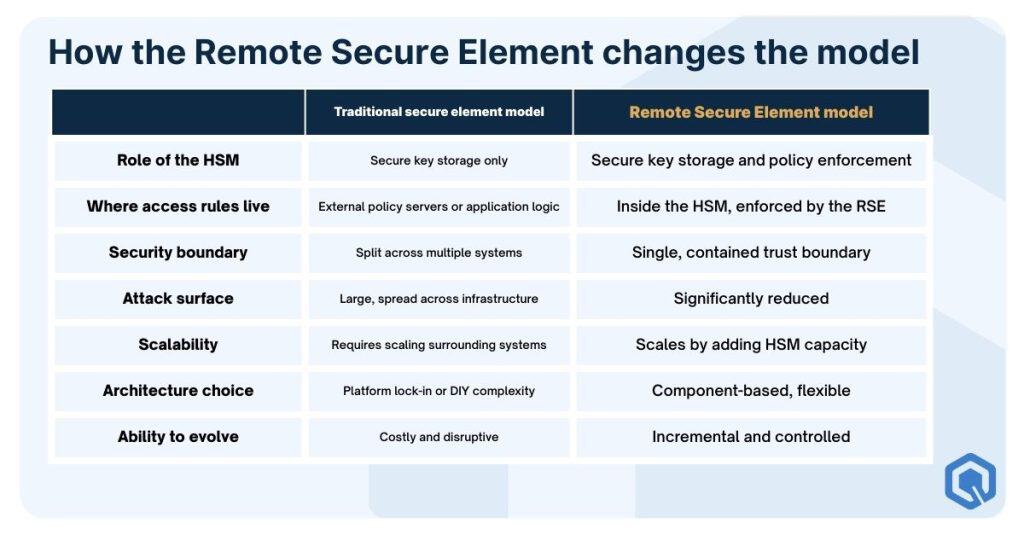
Ubiqu’s Remote Secure Element executes signing logic and policy enforcement as code inside certified HSMs, aligned with ETSI requirements for qualified trust services. Both the cryptographic controls and the supporting operational processes are designed to meet the relevant ETSI standards for key management, access control, auditability, and incident handling as required for QTSP certification. Access rules are enforced within the Hardware Secure Element (HSM), not by external policy servers. Cryptographic keys never leave the HSM and can only be used when all required conditions are met. This reduces the attack surface and simplifies audit scope. Scaling is achieved by adding HSM capacity rather than expanding surrounding infrastructure.

Trusted by

Built for trust-service operators

Ubiqu supplies backend components for operating trust services such as signatures, seals, timestamps, and attestations using code and policy enforcement inside HSMs. This approach simplifies operation and scaling compared to conventional trust-service architectures, while remaining suitable for regulated environments.

Qualified Electronic Signatures (QES)

Legally binding remote signatures executed inside a certified HSM, without device or token dependency

Qualified Electronic Seals (QSeal)

Organisation-level sealing of documents and data, ensuring integrity and origin at eIDAS High.

Qualified Timestamps (QTS)

Trusted, audit-proof timestamps for transactions, documents, and compliance records.

Electronic Attribute Attestations (EAA / QEAA)

Issuance and validation of verified attributes such as roles, licences, or permissions.

The limits of existing trust-service infrastructure

Most trust-service infrastructure is delivered as an end-to-end platform or as a fully outsourced QTSP service. Buying signatures typically means adopting the provider’s entire stack and workflows, leaving little room for architectural choice or adaptation.
Although keys are often stored in HSMs, access rules are commonly enforced outside the HSM, creating complex and high-risk infrastructure that is hard to secure, scale, and evolve.

Boris Goranov

– CEO Ubiqu

A different – more flexible and scalable – way to build qualified trust services

Ubiqu enforces keys and policies together inside the HSM, while keeping orchestration outside the secure boundary, reducing complexity and eliminating the need for external policy servers. Trust services scale by adding HSM capacity, not surrounding infrastructure, giving organisations a simpler backend that can evolve over time.
Operationalising the Remote Secure Element

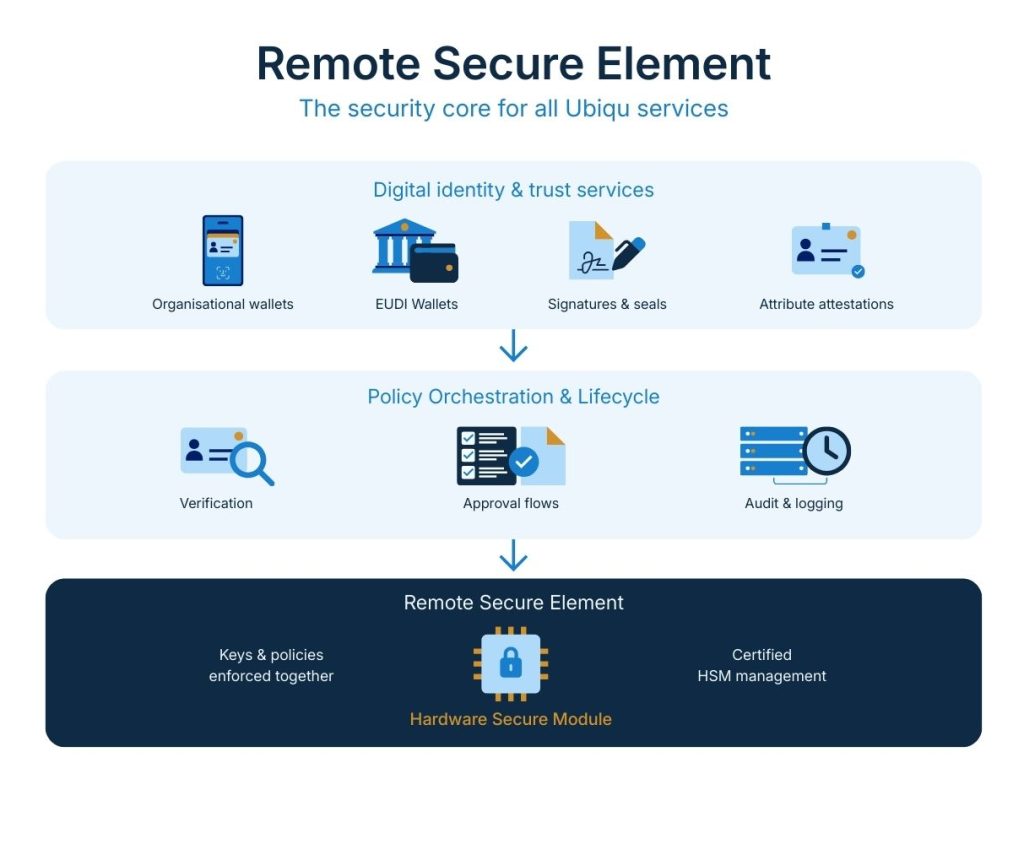
The Remote Secure Element is designed to be used across multiple identity and trust products, not as a standalone component. It acts as a shared security foundation that can be applied where high-assurance identity, access, or trust services are required, while allowing each product to evolve independently.

We provide the backend technology needed to build and run an EUDI wallet. It handles secure identity usage, authentication, and credential operations in line with the EUDI architecture, without depending on specific devices or phone capabilities.

The organisational identity wallet enables secure access to applications, systems, and physical environments using a single digital identity. It supports authentication and authorisation based on roles and verified attributes, while keeping the user experience simple and consistent.

Our trust-service components enable organisations to issue and operate services such as signatures, seals, timestamps, and attestations. They are designed to integrate into existing architectures without forcing adoption of a full platform. Trust enforcement and scalability are handled by a common security backbone.

We enable organisations to build or evolve towards qualified trust services at their own pace. Instead of adopting a monolithic QTSP platform, organisations can assemble the required components and retain control over their architecture. Certified security components provide the foundation when qualification is required.

The unique advantage of the Remote Secure Element for qualified trust services


The Remote Secure Element provides a different architectural foundation for trust services than QTSP platforms with an all-in-one service, or DIY stacks. 

  • Simpler operations, fewer failure points
    Trust logic runs inside the secure boundary, reducing the amount of infrastructure that must be hardened, monitored, and audited.
  • Built for scale, not just compliance
    Trust services scale by adding HSM capacity rather than duplicating surrounding systems, making high-volume signing and sealing predictable and controllable.
  • Modular and future-proof
    Components can be integrated selectively and replaced over time, allowing organisations to evolve their trust services without platform lock-in or re-architecture.

Start building your own wallet with our trusted expertise and technology

Get in touch

This field is for validation purposes and should be left unchanged.